Here I’ll describe the two novels I’ve written. There are others lurking in my head and in some cases partially written. I also have ideas and some work done on a satirical script, and a humorous piece or two. As you may note from other articles on this website I’m pulled in a variety of directions and often finding time is difficult.
Both of these books are available on Amazon for Kindle. Clearly they are excellent for the money!
Dmitry’s Gift
I wrote this a few years ago now and it’s a decent length (600+ pages on Kindle). Set in the Soviet Union during the late 1930’s it describes one man’s journey to a better life, escaping from an uncertain and oppressive society. It is not darkly depressing, or a grey drab angst ridden urban political struggle.
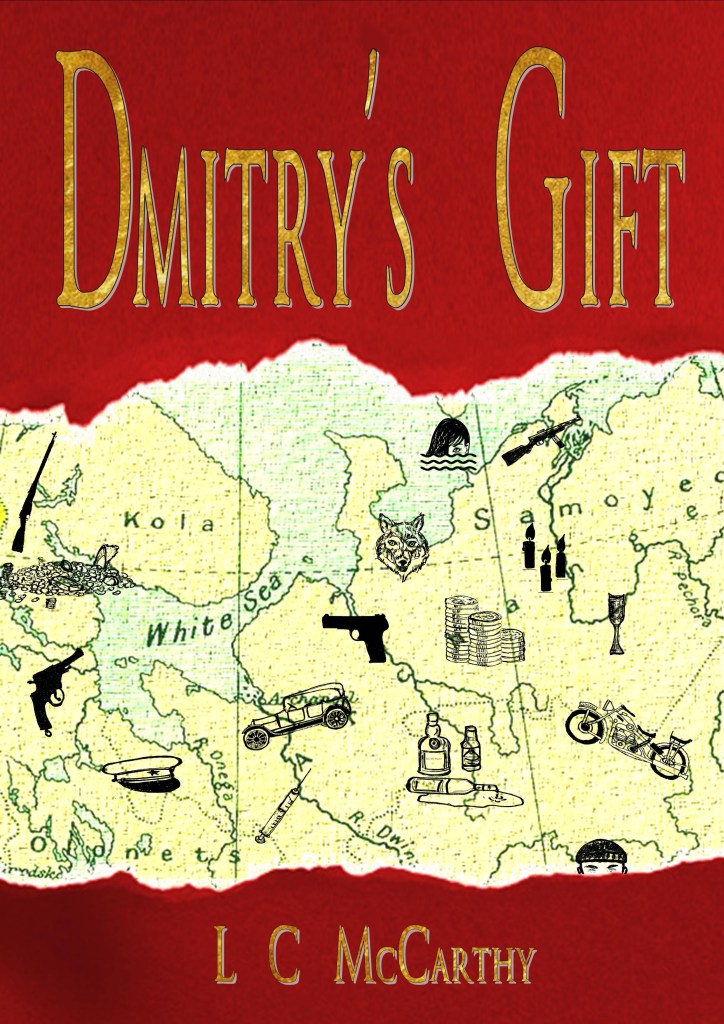
The book is set in a mostly rural/village environment and the intent was to reflect the vastness of the land the protagonists travel through. Hopefully the difficulty in implimenting direct state control is reflected and perhaps seen as farcical in such a huge state, one of the reasons socialism thrives in urban environments.. The fear that controls the people is not really as ridiculous but refelcts how easy it is to control the population by frightening the pants off them. I think it would make a great ‘road movie’, as it involves motorised transport and adventures in different environments.
“The only thing necessary for the triumph of evil is for good men to do nothing,” (E Burke or JS Mill – attribution contentious)
The book is in three main parts. The first focusses on events set in a remote labour camp, part of the Gulag. Gulag is a contraction of the term used to identify the vast organisation that controlled all the facilities using what amounted to slave labour. Hence ‘Gulag Archipelago’, small islands set a in an alien sea. In our modern world civil projects, state run industry and prison services are all funded via the public purse. But what happens if the public don’t have anything? Imprisoning vast amounts of people on petty charges and little evidence ties all three up into a neat little package. Free labour (the prisoner works off his/her debt to society) is utilised to mine gold in Kolyma, dig canals in the Baltic or harvest timber in Siberia. All this was run through the NKVD – the Ministry of the Interior, rather than the sub department GUGB – the State Security branch – with which it is often confused. And not corrupt at all. Honestly! (I’m fibbing)
Part two describes the escape and journey of the book’s protagonist(s). I did a huge amount of research for the whole book, and I believe that if your facts are dubious your story will suffer a lack of credibility. Around 60% of my time spent was research. As I’m interested in this area of history and culture it wasn’t a hardship. I was reading Checkov and Tolstoy at 15, and engaged with Soviet matters often during my military service. I also managed to shoehorn a few opportunities into my later Degree studies.
The final section concerns the events on reaching Karelia and plans for achieving safety. Without spoiling too much I’ll leave the story as it lies.
There is some violence, sadness, happiness, humour and a nice bit of ‘romance’ – quoting one reviewer – (Once you meet Nelly you’ll know it’s not Mills and Boon!).
In closing I’ll just add that my intention was to provide an uplifting narrative against the backdrop of a dark and desperate time, with some victories and smile worthy scenes thrown in for good measure.
I designed, drew and produced the cover myself, learning some new skills in the process. I think it looks pretty good. I did the same for the other novel below. It’s clearly not top professional standard but I’ve seen worse that claims to be.
I would recommend – if this area is of interest – books by Orlando Figes, Catherine Merridale, Simon S Montefiore, Anne Applebaum and Sheila Fitzpatrick. The last two authors’ works, ‘Gulag’ and ‘Everyday Stalinism’ respectively are really accessible and engaging. Brilliant, if sometimes shocking.
Images and Article Copyright © 2025 by L.C McCarthy
Death Sign
This book was written a couple of years after Dmitry’s Gift. It’s much more contemporary and set in the Far East. I am interested in characters that can think for themselves, solve problems and move forward. Rick Huke, the lead character, is a capable man who reflects all those traits. An expert tracker he reads the signs and seeks to understand the world he occupies. I like the Sherlockian idea that taken together the evidence tells a story.
Therefore, I am interested in tracking as a medium by which unseen activity can be visualised. I am not particularly talented – I can follow a log dragged through wet sand on a clear day – but the variables involved; weather, environment, proficiency of the quarry etc, make the task much more complex than may be imagined. To demonstrate – a track’s age can be measured by, for example, how it dries out. How humid is it? Did it l rain before the quarry passed through ? How does the earth drain: sandy, loam, clay? How breezy/Windy has it been during the period after the track was made? Is the track in sunlight or in the shade, and what sun has there been? A lot of information to sift through. Examining more than one piece of sign narrows the data field and gives a more precise finding. Very much an experience based discipline.
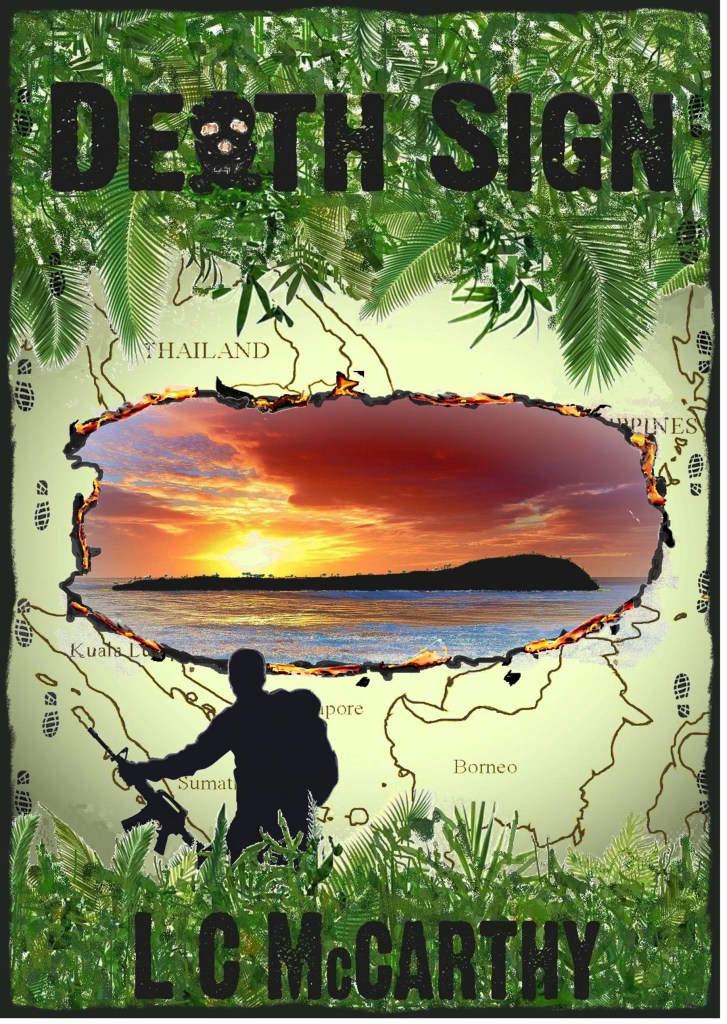
In short Rick, ‘Reg’ to his friends, is tasked with helping an ‘ally’ to recover his brother, missing in the jungles of Sumatra. Betrayed and left stranded on a sinister island he plans his escape and attempts to nullify the threat arrayed against him.
Again research plays a large role in the storyline, probably slightly more than the previous novel, but equally fascinating for me and again not a hardship. There is not just the locations – I spent a while looking at hotel geography; location, floorplans and room images – but the history of the Japanese activity and strategies in the Far East. A lot of input looking at maps, terrain and nature data to ensure feasible journey times and correct plant and animal particulars was required. Some of the weapons were familiar, others not at all. Quite a few intelligence manuals were published by the Allies during WW2 and contained much useful info. Most are available online in PDF: very interesting, even if you aren’t writing a book. I appreciate that for many the detail isn’t as important as it is to me, but I march to my own drum – so there it is!
I looked at, and noted dimensions and features of ships, helicopters, aeroplanes and other vessels. I even examined chemicals and fuels to get the facts right. The recovery of fuel from wrecks is a genuine episode. The USS Mississinewa sank in Ulithi Atoll – the only Kaiten victim – in Nov. 1944.
A reviewer noted a bit of Crusoe-esque activity. He was right, but it goes further with one man using his skills and brain to even the odds against him. A little personal ethos here, namely not being a victim. Understanding the environment and the forces arrayed against you in order to meet challenges forced upon you. Not giving in, or up.
The name Richard Reginald Huke was the name of my Grandfather who resigned from the Merchant Navy in 1914, joined the BEF and earnt ‘Pip, Squeak and Wilfred’ serving in the Royal Norfolk Regiment on the Western Front. Surviving into his late 80’s, he is often in my thoughts.
Images and Article Copyright © 2025 by L.C McCarthy
 L C McCarthy