A previously unknown Ludlum novel just coming to light I hear you ask? Written by an author who is not dead and not very Ludlum-esque, but hoping the name and characters will provide a healthy cashflow? No, reassuringly not. In reality it’s an unfamiliar and misunderstood arrangement that came about around the time of the Norman Conquest of England. Like all the best tales it’s threads spread far and wide across Europe like ripples in a pond. Who doesn’t love a mixed metaphor?
Introduction
We are all familiar with the concept of royal lineages marked with what appears to be an unimaginative preference for the same name. Extensive herds of Edwards, Henrys and Georges have traipsed front and centre through British history for the last millenium or so. This has it’s positives. In a time where there were no newspapers – and if there was people could only use them in the cat’s litter tray, as the vast majority couldn’t read – repeating a name seemed like a good way for people to remember who was supposedly in charge. Keep it simple stupid.
Of course safety in continuity is implied, although often undelivered. There has been the monarchical equivalent of the difficult second album in the shape of the future Edward II and Richard II*, both of whom failed to even come close to the previous holder of the name. Some may add Henry II who made some serious blunders. Ridding himself of a turbulent priest being the real faux pas, as Becket was top muckers with the Pope, who was still quite important then. Hal made ammends by humbly stripping off his finery and walking barefoot to Canterbury. Once there he was whipped as a pennance, adding to the discomfort of his already lacerated feet. How demeaning. Imagine Prince Andrew bimbling along the A2 wearing Budgie smugglers, Sliders (health and safety) and a Gimp mask. Unthinkable!
(*The third efforts constituted some redemption – Eddie 3 was very successful – ‘Arrows in your Poitiers’ and ‘Up your Crecy’ being standout tracks while ‘My Black Prince has gone’ was a real tearjerker. Rick 3 not so much, and got very poor reviews from Shaky, who got the hump with it. Now seen as a cult sleeper – mostly in Leicester under a car park – many are still undecided on the haunting ‘What did you do with those boys, Dick!?’).
When we pick up the ‘Matilda’ story in the 11th century Europe had already started implementing a more austere, less frivolous, looking line up. The Carolingians (Charleseses…es?) in France had started well centuries before with Charles Martel (5*) and Charlemagne but erred a little with Childebert the Adopted and Drago of Champagne (which I mistakenly thought was 18 standard bottles of the fizzy stuff). The following handful of Pepins/Pippins carried a strong whiff of puppet-wielding childrens entertainer, but it was the accession of later ‘Charlies’ that may have been the catalyst for change. Charles; the Fat, the Simple, the Bald, and the Child were joined in the ‘Name for Derision’ competition by Louis; the Stammerer, the Blind, (another) the Child, and of course that most unacceptable in France, the German. Which could only have been made worse if Louis ‘the English’ had popped up. Louis the IV and V pioneered a numerically less mirth inducing system in the tenth century.
Therefore, it’s not suprising to see that with the forthcoming twinning of London and Rouen, the new empire of Normandy and England, efforts should be made to start as one meant to go on. The need for action was made paramount when some of the Anglo Saxon nomenclature was examined.
Origins
Early chieftains such as Edwig, a pale lad with a face resembling an owl and a very high voice, not dissimilar to Aled Jones – once engaged to Offa’s ex-wife who went right off men and had a landmark named in her honour – was known throughout his abnormally long life (died aged 37) as ‘Toupee Ted’.
Ethelbert, the eighth century king of Kent was one of the earliest recorded persons of conflicted gender identity. Although ‘they’ may have been more at home in a 1960’s british sitcom they actually spent all of their time doing that half & half thing, dressed as a man on left profile, and a lady when turned to the right, employing both a bass and a soprano voice as they had pretentions toward musical theatre. Sycophants claimed it to be hilarious and very clever, but it wasn’t – a lot like mime which also isn’t.
However, it was the female royalty that were the real worry.
Splendid nominative deterministic-ish examples are the legendary wives of King Edward ‘the Elder’ (fl. 900 AD), Son of Alfred the Great, father of 16, and clearly an admirer of what Hamlet terms ‘Country Matters’. The first, Egwina, known for ferociously attending village fetes armed only with a spoon, was suceeded by Elfleda, famous as introducing the first pack system for occupying small girls, preceeding the Brownies by many centuries, when she gave birth to eight girls (not all in one sitting). She may have been an inspiration for the folk tale Snow White, although while the names of her children are not very well known, Grumpy, Doc and Dopey seem unlikely: Probably something beginning with ‘E’. The last wife – we can assume the previous one was fairly worn out – was named Edgiva. This was not a nickname, although the slightly more exotic ‘Fellatio’ doubtless was. An insider reported – according to the tabloid journos of the time, the Clergy – that many of the ill-educated local noblewomen thought she was ‘a bit up herself’ with her fancy Italian name.

Edward’s Son, Edmund I – ‘the Magnificent’ -followed, (crowned 939 aged 18 and died just over 4 years later so how he got to be so ‘magnificent’ so young and in such a short time is not known – fill the gap yourselves but try and keep it clean) and had a problematic pair (I didn’t miss an opportunity here – I passed). What a longer reign might have produced beggars belief. His first wife was Elgiva and following the descriptive tags so far employed we can only summise that Edmund had his ear bent regularly and she was an early medieval Hyacinth Bucket/Dot Cotton hybrid. His second wife Ethelfleda spent extensive periods apart from her husband as she may have been suffering from an early form of Dromomania. This could have contributed to Edmund’s early demise as he was stabbed outside a pub in Pucklechurch (Bristol) trying to get hold of a local outlaw. It may be the knife wielding regicide had information as to the location of the errant wife, we will never know. What we do know was that Ethelfleda was actually visiting a local girl she knew from school* – where they’d shared pies behind the bike shed, although it was just a shed as the bike wasn’t invented for another eight centuries or so. The incessantly pregnant Ethelspreda, a timeworn 17 year old with six kids, was in dire need. Too large to beg and unable to buy any new leggings – the last pair had split and she’d been fined for publicly exhibiting an unlicensed pet in an inappropriate place – Ethelfleda was her saviour. She’d fed the children copious amounts of ale, paid the fine and handled the unkempt pet matter, ensuring it remained firmly penned in….Thus preventing the kind of scenario that keeps Channel Five rich in material for documentaries.
(*Ethelspreda didn’t actually go to school, just hung around outside hoping to get lucky.)
A time for action
Something had to be done in order to prevent being a future laughingstock. In many ways this shows great foresight. Imagining future ancestors finding fault and holding us up as foolish is not something we do well nowadays. We do the ‘how stupid were people in the olden days’ bit, but not for one minute do we think the future may mock us. Undoubtably they will for being smug enough for believing we are so incredibly clever, which we aren’t.
The King numerical naming bit was fairly straightforward, even if most people were crap at counting. They didn’t have any money to count and therefore they didn’t really matter. When modern readers earnestly enquire, with fake sincerity dripping from every word, ‘but what about the People : that’s who I really want to relate to..’, (insert air quotes here), the people really didn’t matter. That’s it. It’s not in the Guardian but it’s true.
The Queen consort it was decided, the potential power behind the throne (fat chance as it turned out as no ‘Catherine de’ Medici’ types of note appeared), should not be disadvantaged by suggestive names beginning with ‘E’. The Conqueror had mused for hours over his Great Aunt ‘Emma’ of Normandy but failed to find anything naughty there to get upset about or go to war for, not even an anagram – although he faired somewhat better with her dead husband. It was decided that a good name should be advanced and measures taken to ensure some longevity. Adela of France, wife of the Count of Flanders suggested Matilda.
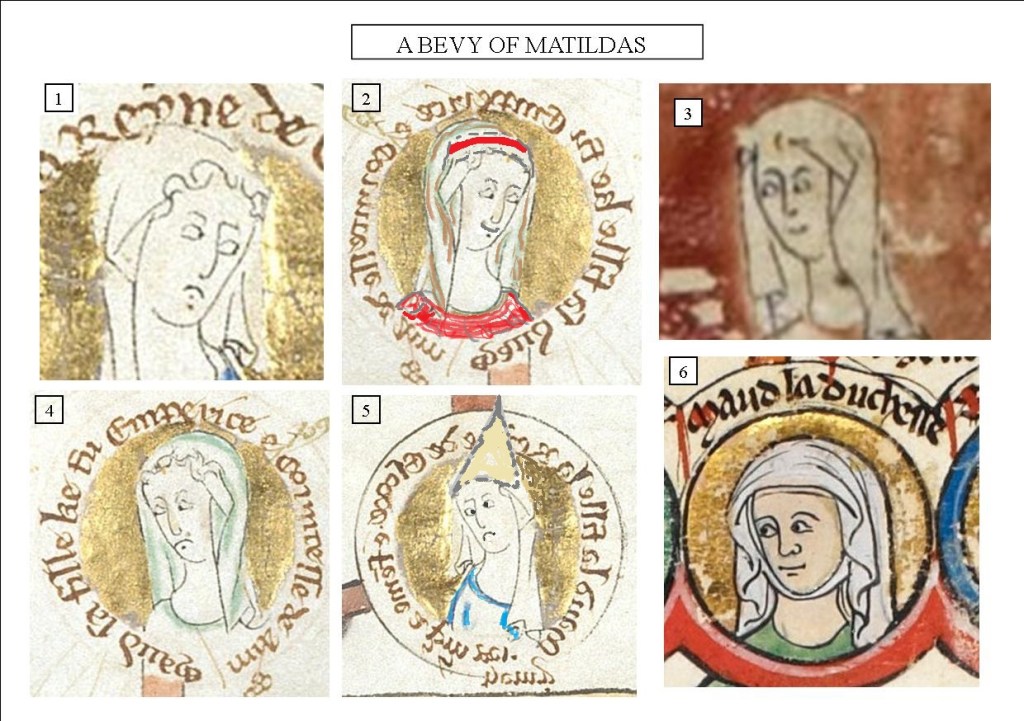
The Matildas
- 1. Matilda nee Edith of Scotland.
- 2. Postulated to be Matilda of Anjou, as, although very aquaphobic, she habitually wore red in order that the Coastguard coracle could spot her easily. Just in Case – you never know!
- 3. Surmised to be Matilda of Flanders, Mrs Conqueror.
- 4. Empress Matilda – Daughter of Henry I, Mother of Henry II.
- 5. Speculated to be Matilda, daughter of the Conqueror and Grand Maud. Seen here wearing the ceremonial Hennin which only really caught on a few centuries later. It was nearly binned by ‘Maud’ as she got pissed off with people shouting ‘Mines a 99!’
- 6. Matilda of England, daughter of Eleanor and Henry II. Potential Olympian.
The likeness amongst the Matildas is amazing, the gene pool so miniscule it would have made a Habsburg wince. The fine features so richly portrayed in such detail takes your breath away. The way the eyes follow you around the room is petrifying. Most look disparaging at best with very much the disdainful valley girl look to the fore. Probably doesn’t help that the Grand Maud was clearly occularly challenged – high and low beam. Trips to the hairdresser were out of the question as Vidal Sassoon had not been invented, and coffee and Hello magazine were years in the future. The ‘Taie d’oreiller sur le caboche’ is utilised to keep it tidy, and cut down nights in ‘washing my hair’.
The Conference
A large gathering in Rouen was proposed mid century to formulate a strategy. It turned out much smaller than anticipated, as only eight turned up. The Germanic states didn’t send anyone as the hundreds of tiny municipalities couldn’t agree on who to send. Clearly the firm hand of an unfeeling tyrannical force with cockeyed territorial ambitions could have found a home here – The Kaiser, Adolf or the EU….. You choose. But that would all come later, and for now the Holy Roman Emperor stepped in and sent his mother in law and his personal masseuse, feeling what is given in one hand is taken by the other – plus his wife was getting suspicious. His mother in law was stunning for her age, and was considered to be the Joan Collins of her day. The masseuse name was Malthilde Bustenhalter – The Emperor considered it a nice touch.
Many of the mediterranean states were very busy dealing with boat borne incursions from the Arab world* and felt women were better off at home doing domestic things. As it was they’d only been invited out of courtesy, and with the hope that they’d arrive weighed down with deep pan pizza, Kebabs and Rioja. They had little interest in English politics and baulked at straying too far northward, especially during the holiday season**. Various small dumpy sun-darkened little old ladies dressed all in black were rounded up over the course of the conference by the Rouen city guard, and could have been sent from anywhere on the northern mediteranean coast but nobody could understand them – and all the Ambassadors claimed ignorance, although the Croatian ambassador immediately departed to Biaritz for his ‘health’. Additionally, the women could not, or more likely refused to, understand each other beyond poking fingers at their antagonists and making seemingly rude gestures which were clearly universally understood. Many stayed on in Rouen where parents of young girls employed them to sit in their front gardens frightening off potential but unwanted suitors. Once the sight of these formidable glaring and squawking dark creatures gesticulating wildly were common, but twitchers undocumented sightings had faded from memory by the 12th Century.
(*,** A few decades later this became a larger problem and the Pope, under pressure from the Bishop of Tui, whose diminishing Papal contributions were disturbing, initiated the First Crusade. Safety for Holidaymakers, Tourists, Pilgrims was re-established and the popular ‘Fortnight* in the Holy Land + free souvenir relic’ package was once more reeling in the impressionable punters pious and faithful. {* – plus one months travelling from a port of your choice, as long as it’s Marseille}.)
 L C McCarthy